India Inc had cheered Donald Trump's decision to scrap TPP, but now there is a growing sense that it won't really lead to positive growth in trade with the US. Subhayan Chakraborty reports.
While he has plenty of critics at home, Rajan is a favourite among foreign investors and has been credited for bringing inflation under control.
The major driver of Mod's foreign policy can be gauged from his economic priorities such as creating employment opportunities for the youth bulge. Related to this is emphasis on manufacturing, and infrastructure development, which in turn raises the issue of FDI. He has already articulated his views on all these issues, says Rup Narayan Das.

'The title of 'core' of the leadership gives Xi Jinping greater political authority at a time when China is beset by various problems as well as a slowdown in economic growth,' points out former RA&W officer Jayadeva Ranade.
ndia has said it is ready to sign the global trade deal as early as next month if other WTO members agree to its demand for concessions on food subsidies.

The Middle East's power house is about to get a new ruler who is only 31 and he may lead Saudi Arabia for decades, says Ambassador M K Bhadrakumar.

Chinese President Xi Jinping has announced that the 2.3 million strong People's Liberation Army, the world's largest, will be trimmed by three lakh.

Modi is keen to get more investments into Gujarat.
.jpg)
Both India and China have demonstrated levels of maturity in diffusing tensions and ensuring that the border remains by and large incident free, says Seema Mustafa
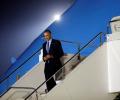
'Obama's visit to Hiroshima must generate a fresh debate in the international community about how to reduce the salience of nuclear weapons in international politics and how to disarm the world from these monstrous weapons forever,' says Sanjeev Shrivastav..
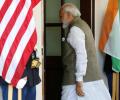
We see none of the euphoric build-up customary to India's encounter with US presidents in recent times. This gives Modi wriggle room to work on the much-needed reset of India-US ties.

The India that needs strategic alliances, defence cooperation and engaging meaningfully with neighbouring countries is quietly moving ahead with confidence, says Tarun Vijay

Saudi Arabia's Saudi King Abdullah bin Abdulaziz died on Friday and his half-brother Salman took over reigns of the world's top oil exporting nation in a smooth transition of power, calling for "unity and solidarity" among Muslims.

'Islamabad receives billions in aid from the US but continues to harbour terrorists,' he said.
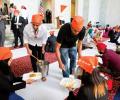
Members of the United States Congress break bread to celebrate the contributions of Sikh Americans. Rediff.com's Aziz Haniffa reports
The second and final part of former cabinet secretary Naresh Chandra's interview to Sheela Bhatt.
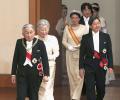
The emperor has no political power, yet he enjoys a unique place in Japanese society, notes Dr Rajaram Panda.

Being a pragmatist Modi is not likely to give preference to China over Japan. Both security and economic aspects are likely to shape Modi's decision in terms of engaging the two biggest economies of Asia, says Sana Hashmi.

The explosion aboard the country's frontline submarine 'Sindhurakshak' was quite a setback, said former commanders and top naval experts, even as they expressed hope that the Indian Navy would soon be able to set things right.

'The same charm that draws men to the armed forces, also draws women. It is love for the nation and honour and pride in donning the uniform,' says Lieutenant Colonel Sofiya Qureshi, the first woman to lead the Indian Army in a 18-nation military exercise.

'With the recent challenging of the notion of the Indian Ocean Region being India's strategic backyard, China is gradually upping the ante in the maritime realm around India.'
There were heightened expectations from Budget 2017 after the impact of note ban on different sections but most remain unfulfilled.
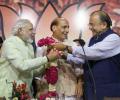
Modi has the ideas for a new, hopeful India, and an idiom in which to sell optimism to voters. But he doesn't yet have the team for it, and soon enough, questions will begin to be asked by an impatient, non-ideological, I-don't-owe-anybody-anything generation of Indian voters, says Shekar Gupta.

'India was in no position to wage another war in 1965, having suffered a morale-shattering defeat in 1962. The three services were in the middle of a modernisation and expansion phase and therefore not fully trained or battle-ready.'

Contrary to the bragging that marked its two-year anniversary, the government's timidity on reform is simply astounding.

Outlining seven principles of engagement for closer cooperation between India and China, Prime Minister Manmohan Singh on Thursday said the two countries should show sensitivity to each other's interests and sovereignty and move quickly to resolve the boundary issue.

China's economy is in transition, with rising wage costs and massive overcapacity.

'What is the ISI doing and why can't they understand for their own interest that bringing stability to the region will help all the countries become prosperous, whereas a continuation of incitement will only lead to misery for all.'

Asserting that "maritime muscle flexing" by some countries and other factors have made the Indo-Pacific region "more contested and more volatile," naval chief Admiral Sunil Lanba on Tuesday said that the Indian Navy has its task cut out as it has been a major security provider in the region.

From early indications, the Modi government's foreign policy seems to be pragmatic and reciprocal, says K G Suresh.
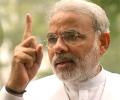
'The speeches of Modi in Assam, Bengal, Kerala, Baghpat and the border areas of Bihar, overplaying the themes of terrorism, izzat of mothers and sisters, are to be read carefully to understand that he is trying to keep the fear of Muslims alive in the Hindu masses,' says Apoorvanand.

I still believe that it is a good thing that think tanks are mushrooming in Delhi. They provide a platform for discussion, even if they shed more heat than light. With Parliament almost incapable of serious debate, informed discussion and civilised discourse, where does this nation get its intellectual churn, asks Mohan Guruswamy.

India's unusual tough stand on the arrest of its diplomat Devyani Khobragade has forced the United States to initiate an "inter-agency review" to look into the lapses that happened in the high-profile case that triggered an uproar in India and strained bilateral ties.

'The surge of Saudi nationalism is the last thing Washington wants,' says Ambassador M K Bhadrakumar.

If the wave has become a tsunami, why is the BJP's prime ministerial candidate playing safe by polarising voters along communal lines, asks Bharat Bhushan.

'Today the Chinese think they can slap India, and there will be no consequences.' 'They must be made to feel the consequences through any and all means,' says Rajeev Srinivasan.

'The creation of Pakistan was integral to Britain's grand strategy.' 'If they were to ever leave India, Britain's military planners had made it clear that they needed to retain a foothold in the NWFP and Baluchistan because that would provide the means to retain control of Iran, Iraq, Kuwait, the UAE, Bahrain and Qatar.'

"They call me the Class 10 vice-chancellor," he says as his thin lips flirt with a smile. You almost feel that the tall man of spare build is being facetious. And then you see that his deep set eyes are not twinkling. There is a sense of the combative in them.
An airport in Noida could lead to higher user fees and diversion of traffic from Delhi, which has huge unused capacity.
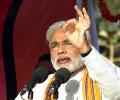
The kind of people Narendra Modi has chosen, the decisions he has taken and the rail and central budgets suggests that he is treading carefully in New Delhi. There is less of innovation and more of continuity, so far. He is not ready to rock the boat and start from scratch, says Sheela Bhatt.
